WalletRadar
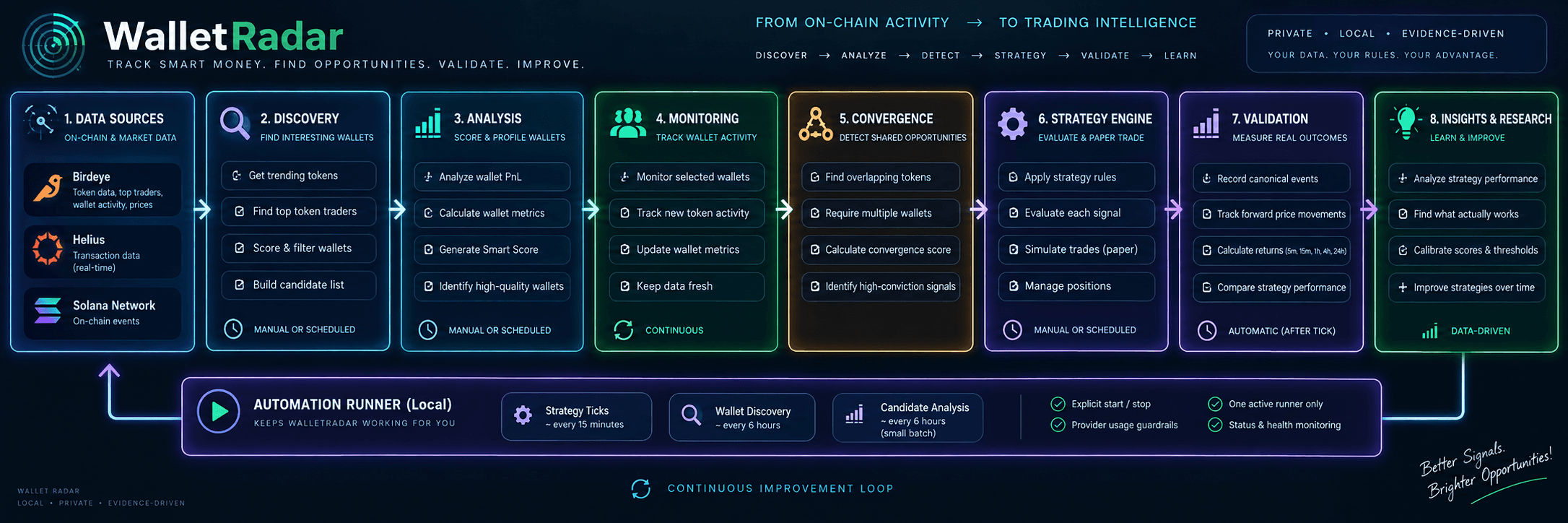
Solana wallet-intelligence and paper-trading research platform — ranks wallets by a composite Smart Score, surfaces tokens that multiple strong wallets converged on, simulates strategies against live prices, and measures whether those signals actually predicted price. Research only: no wallet signing, no on-chain transactions, no real trades ever placed.
Role
Developer
Problem
Gives researchers a way to find consistently strong Solana traders and test strategies against them without financial risk — the analysis, the convergence signals, and the trading simulator all run on real market data while staying entirely virtual, and a separate validation view checks whether the signals hold up at all, independent of whether any one strategy happened to make money.
Tech Stack
How It Works
- 01Discovery and batch-analysis jobs pull candidate wallets and look them up against Helius and Birdeye for on-chain Solana transaction and price data.
- 02A scoring pipeline computes cost basis, classifies each trade, and aggregates PnL, ROI, and a composite Smart Score — tagging every non-exact figure with its reliability, and showing "Unavailable" rather than a guessed number.
- 03Scored wallets land on a leaderboard with URL-driven filter presets, each linking to a detail page for score breakdown, open positions, classified trades, and Smart Score history — served from cached Supabase data so browsing never burns API quota.
- 04Smart Money convergence flags tokens that several tracked, non-bot wallets bought inside a rolling time window.
- 05The Demo simulator turns those signals into paper trades — simulated fills at current market price with unfavorable slippage and fees — tracked as an equity curve against a SOL benchmark.
- 06Signal Validation records each convergence event once and resolves its price return at 5m, 15m, 1h, 4h and 24h from WalletRadar's own detection time, keeping why each strategy traded or skipped it as a separate question from whether the signal worked.
- 07A local automation runner, outside the Next.js process and restricted to loopback, keeps strategy ticks, wallet discovery and candidate analysis going unattended — ticks and heartbeat on independent loops, discovery and analysis serialized by priority under a daily budget.
What I Learned
- –Reconciling two different blockchain data providers (Helius, Birdeye) meant normalizing inconsistent data shapes and rate limits into one coherent model.
- –Designing a fair scoring formula across wallets with very different trade volumes was harder than expected — naive PnL ranking rewards one lucky trade over consistent performance.
- –A paper-trading simulator is only worth anything if it refuses to flatter itself: entering at the current price rather than the source wallet's historical one, and charging slippage and fees, is the difference between a believable backtest and a fantasy.
- –Treating data honesty as a feature — reliability tags on every derived figure, cached reads by default, and no fabricated values — made the numbers trustworthy enough to actually act on.
- –Measuring a signal honestly needs rules that resist optimism: a horizon's outcome prefers the first price observed at or after its target time, never a closer earlier one, and an early approximation is tracked but kept out of the headline win rate.